
Silence instead of Brightness – My Journey into Japanese-Inspired Painting


The fascination of Japanese painting
There are cultures in which painting is always an image of the world: detailed, explanatory, almost documentary. And then there is Japanese art, which speaks an entirely different language. It is less an image than a mood. A fleeting moment disappearing into the mist – and yet, or precisely because of that, it resonates so deeply.
Ink painting, Sumi-e (墨絵), is equally fascinating. There, one does not spend hours polishing details – instead, a single stroke decides everything. The result cannot be corrected, cannot be retouched – and that makes it so honest. Every stroke is final, yet full of life. A bamboo branch in Sumi-e may consist of three or four lines – and yet you recognize it immediately, not only outwardly, but in essence.
But Japanese art is not only about reduction. One of my great favorites is Itō Jakuchū (伊藤 若冲, 1716–1800). He was the opposite of a minimalist: a master of colors, a painter of exuberant imagination. His animal and plant paintings burst with life – and yet they have a clarity that never feels chaotic. What moves me so deeply about Jakuchū is his ability to create harmony within abundance. Every detail is placed with intention, nothing arbitrary, and yet everything breathes.
For me, this is the essence of Japanese art: the balance between abundance and silence, between stroke and emptiness, between detail and atmosphere. This attitude inspires me – not because I want to "adopt" it, but because it offers me a new perspective on my own painting.

Why a new style?
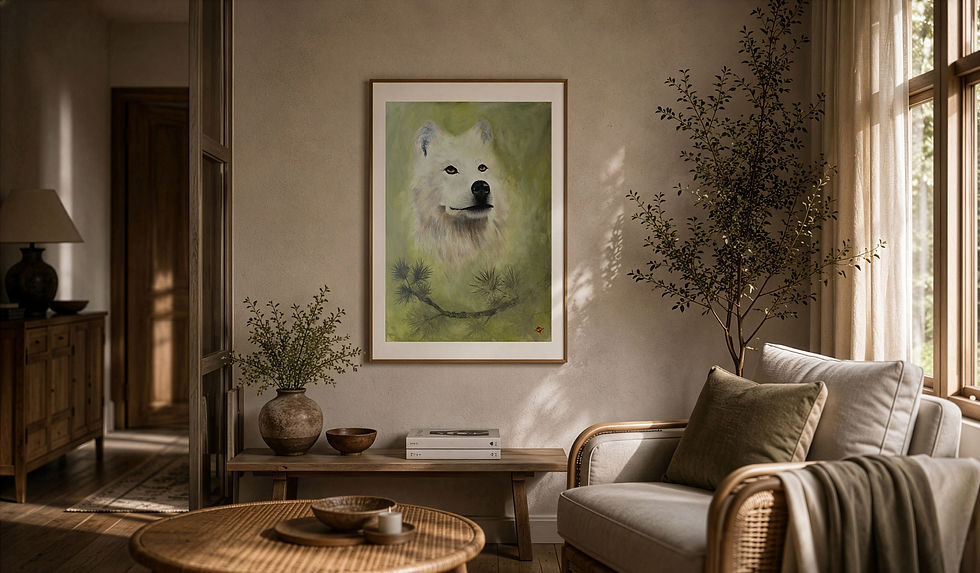
For many years I painted animal portraits. They were full of color, full of energy, often with intense gazes and strong emotional presence. I loved this phase – and yet, at some point, I felt it no longer expressed my inner truth.
It was almost as if I were watching myself from the outside: my animals, powerful on the canvas, while I felt smaller and smaller beside them. The more I developed, the clearer it became: this kind of painting was part of me – but no longer the part that wanted to speak now.
Today I feel: I no longer want portraits. No fixed faces, no frozen moments. Instead, I long for movement, for landscapes, for nature in all its forms. For mist that flows, for flowers that wither, for mountains that vanish in the rain.
My old style now feels like a colorful chapter of my diary – a beautiful chapter, but one that has ended. Still, I do not want to deny it. I want to build a bridge. I will adjust my last animal paintings so they feel right to me – less glaring color, more calm, perhaps a hint of mist, perhaps muted backgrounds. They shall serve as transition works: small bridges between the energy of the past and the silence of the future.

What Japan did to me
My journey to Japan was not about checking off tourist attractions, but rather a quiet sense of wonder – with Kyoto as the center. I remember walking through Japanese gardens: raked gravel surfaces, moss islands like tiny landscapes, ponds reflecting trees and sky. And although there were many people around me, an indescribable silence lay over everything. It was as if every step, every voice was swallowed by the stillness of the surroundings.
This experience left a deep mark on me. In Kyoto I understood that silence does not depend on the absence of people, but on an attitude. A Japanese garden is never empty or "finished" – it lives from the balance of order and nature, of what is planned and what is accidental. And that’s exactly how I felt: as if even my chaos in the studio could find a place in this balance.

Particularly striking for me was my visit to the Tō-ji Pagoda. There I saw an exhibition of the artist Kazuhisa Kusaba, whose ceramic paintings overwhelmed me. His works unite so many opposites: they are detailed and yet full of emptiness, modern and yet deeply rooted in tradition. I stood in front of these works for a long time, realizing that I, too, was searching for something similar in my own painting: a bridge between what was and what is yet to come.
The shrines and temples of Kyoto also showed me how strongly places can affect us. Each shrine was more than architecture – it was atmosphere. The scent of wood and incense, the gentle creak of floors, the rustle of leaves in the gardens. All of it felt like a painting made of sounds, smells, and silence.
Japan showed me that art does not need to be loud to move deeply. It may whisper. It may leave space. Like a garden or a temple, it may become a place where one can breathe. That is exactly what I want to seek – and find – in my paintings.

My new direction
After all these impressions it became clear: I must change my painting. Not a little, not in small steps – but fundamentally.

In the past, animals were the center of my work. Their eyes, their expressions, their presence – that was my form of expression. Today, however, I am drawn to nature as a whole. No longer the portrait, but the landscape. No longer the individual, but the interplay. Mist spreading. Grasses swaying in the wind. Mountains fading in the haze. Flowers lighting up and fading again. Everything nature gives may now find a place on my canvas.
Less color, more breath
My palette is changing as much as my subjects. Where once strong tones dominated, now muted colors prevail. Misty gray, broken white, moss green, ocher tones, a soft hint of blue. Stronger accents appear only rarely – then placed deliberately, like a breath that flickers briefly and vanishes again. It is almost as if I now use color as atmosphere, no longer as the main figure.

Sumi-e as teacher
The technique of Sumi-e is like a silent teacher for me. I am learning to understand the ink: its delicacy, its life of its own, its unpredictability. A stroke, a breath of water – and the picture is decided. I want to carry this attitude into my own painting – not to simply copy tradition, but to let it flow into my work like a memory. Perhaps as a single line, a texture, or the clarity of an empty space.
My own style
In the end, I do not want to paint "European Sumi-e." I want to find my own way. I am experimenting with color gradients reminiscent of mist, with moving forms that only hint at animals or landscapes instead of describing them. Sometimes a text will appear in the painting – a poetic sentence, a trace of thought. And perhaps I will also use chameleon paints that shimmer and change in the light – as a small play with impermanence.

Daring something new
The most important thing for me: the courage to try something new. I do not know where this path will lead. I only know that it draws me. Art has always been a place where I am allowed to lose myself. In strokes, in gradients, in the silence between two colors. And it is precisely this losing of oneself that I want to make visible.
Perhaps some works will fail. Perhaps some will not work at all. But that, too, is part of it. Because only by experimenting can I find something that is real. And I do not want to paint a copy of myself – I want to move forward, remain curious, try new things.
Chaos allowed
And to be honest: my studio remains chaotic. Even if the paintings are becoming calmer, my table is still full of paint jars, paper scraps, and heaps of brushes. But perhaps that is the most beautiful realization: tranquility does not lie in the outside, but in the picture itself. Everything around it may remain messy.

Conclusion – A new breath
Kasumi means "mist" (霞). For me it is not just a name, but a path. Mist is what lies in between: intangible, unfixed, and yet present. It conceals and reveals at the same time, making the world more mysterious.
That is exactly what I want to express in my art: paintings that do not proclaim loudly, but suggest softly. Paintings that leave space for your own interpretation, for your own silence.
I will not hide my old animal portraits – they are part of me. But now a new chapter begins. One in which mist, landscape, nature, and flowers play the leading role. A chapter in which I paint less, but say more.
And in case you wonder how quiet my studio really is: usually only until I once again catch my sleeve on a brush or spill golden milk over my sketch. But maybe that is exactly the meaning of Wabi-Sabi – the beauty of imperfection, the chaos beside the silence. And I believe that is where I feel at home.

Comments